Illegal Drugs
Illegal drugs are a fact of life in the U. S. and most other countries. Most illegal drugs can be easily attained just by "asking around." Though possession and/or distribution of illegal drugs can carry stiff penalties in some locales, in most states, simple possession carries lesser penalties than distributing illegal drugs.
Marijuana and hashish are the most often used illegal drugs in the United States, as 14.6 million people per month, 12-years-old and older use this illegal substance. Many argue that marijuana should be legalized beyond the bounds of 'medical marijuana' but until this is the case, marijuana will be reported and analyzed as an illegal drug.
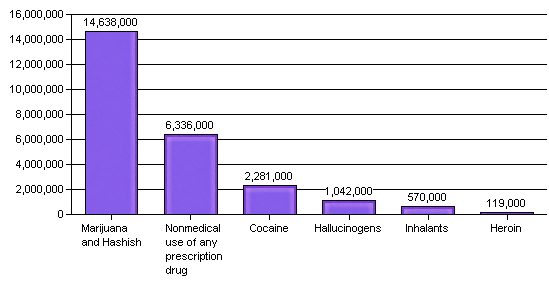
Illegal Drug Chart
Next to marijuana and hashish, the most often abused drugs are non-medical uses of prescription drugs at 6.3 million per month, cocaine at 2.2 million per month, hallucinogens at 1 million, inhalants at .5 million and heroin at 119,000 per month. This information comes from the "2003 National Survey on Drug Use and Health" and does not include information on amphetamines, methamphetamines, ecstasy or some other well-known classes of illegal drugs.
Federal drug control spending has almost doubled from 1996 ($6.2 billion) to 2003 ($11.4 billion) yet the number of drug cases in the courts remains at a stable, yet unacceptable rate. Some states have all but given up the War on Drugs and in a flight of fatalism have decided the somewhat questionable method of taxing the drug dealers.
The Kansas Department of Revenue states, "In order to protect against any possible violation of the self-incrimination constitutional protection, a dealer is not required to give his/her name or address when purchasing stamps and the Business Tax Bureau is prohibited from sharing any information relating to the purchase of drug tax stamps with law enforcement or anyone else. The stamps must be affixed to the drugs when they are seized to prevent tax liability. Payment of the drug tax (the purchase and affixation of stamps) is due immediately upon acquisition or possession by the dealer. The stamps are valid for 3 months from the date of issuance. If drugs are seized without stamps or the stamps which are affixed have expired, the possessor is liable for payment for the tax as well as a penalty of 100% of the assessment."
But, there is still hope in other states. Recently, a number of "drug courts" have appeared within the criminal justice system to deal directly with those accused of illegal drug possession or nonviolent crimes committed by drug users. The idea of the drug courts is to substitute mandatory treatment for incarceration. In addition, use of illegal drugs by employees is down as percentages of positive tests for illegal drugs has dropped from 13.6-percent in 1988 to 4.5-percent in 2003. Of course these statistics could also mean than illegal drug users are getting more technologically advanced by using more sophisticated means of cheating and beating the drug tests.
All in all, though, illegal drug use has stabilized statistically. Some say that it has stabilized at a much higher-than-acceptable rate. Prevention, identification and treatment seem to be replacing incarceration as the main ways to deal with the national illegal drug problem.
|
