Alcohol Testing
Alcohol testing has come a long way in recent years. In fact, manufacturers now sell home alcohol testing kits or wheels for use at home, parties or other activities where one wishes not to drive afterwards, but not be over the Blood-Alcohol Concentration (BAC) limit. Employers, schools and others are also requiring alcohol testing as a condition for retention. Those who have been pulled over for suspected DUI know well that alcohol testing is required by the police officer at the time you are stopped.
Blood Alcohol Guide
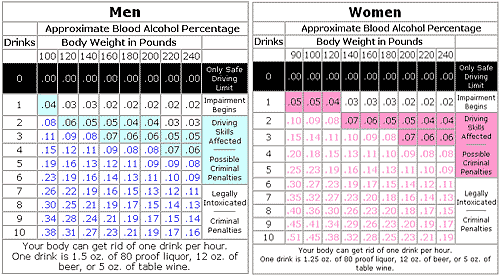
For purposes of this guide, "one drink" is equal to 1.5 oz. of 80 proof liquor, 12 oz. of regular beer, or 5 oz. of table wine. Your results may vary since many factors such as age, gender, physical condition, amount of food consumed and any drugs or medication may influence these results. The best advice is to abstain. Data supplied by the Pennsylvania Liquor Control Board.
Employer Alcohol Testing
Many employers require alcohol testing as a part of the pre-employment screening process. The employer will generally pay for such testing and may refuse to hire an individual based on the test results. As of January, 1996, employers who have drivers on their workforce (with Commercial Drivers Licenses) such as school bus drivers must have an effective alcohol testing program in place. Employers must conduct alcohol testing that is random, under reasonable suspicion, as part of return to duty, follow-up and when an accident has occurred.
School Alcohol Testing
School alcohol testing at school events is becoming more popular. Many teachers have dreaded chaperoning dances only to deal with several trips to the hospital for alcohol poisoning with their underage students. Many schools are now testing students who enter school dances, including proms, with Breathalyzers. Others say that testing kids as they leave events is the way to go since this will ensure that they are not leaving the school and driving drunk.
Some schools have expanded their alcohol testing policy to other events such as night football games as well. Critics say that instead of spot-checking kids as a way of punishment it would be better to deter kids with advanced warning of the alcohol testing instead.
DUI Alcohol Testing
DUI (or Driving Under the Influence) alcohol testing is usually administered by a police officer using breathalyzer equipment and/or a series of field sobriety tests developed by the National Highway Traffic Safety Administration (NHTSA). Some of the basic field sobriety tests include Alcohol Gaze Nystagmus test, standing on one foot, walking imaginary line, finger counting and alternate clapping.
In some states a driver can choose a blood test or a urine test in lieu of the breathalyzer test. One of the newer machines is a "datamaster" which is much less complicated to use than a breathalyzer. The "datamaster" prints out a ticket with your mechanically determined breath test results, and no interpretation is required.
For most states, having a BAC of .08 or above (.10 in some states) is the threshold for being declared legal drunk.
Alcohol Testing Kits
Besides the breathalyzer, datamaster, blood and urine screening methods used by trained professionals, there are also home alcohol testing kits one can purchase in hopes of helping oneself, family or friends avoid a DUI ticket or a lifelong problem. Some of the kits include alcohol saliva kits, drink wheel calculators, urine kits, personal digital breathalyzers, hand-held pupillometer and many others.
Alcohol testing is here to stay. Since alcohol-related deaths account for 85,000 to 100,000 people annually in the U. S. alone, alcohol testing has become part of our day-to-day culture. Those who have alcohol dependency problems or are heavy drinkers should seek immediate help and not use alcohol testing as a means to avoid getting the needed help. When used correctly, to help oneself, one's family, friends or coworkers, alcohol testing can help save lives and this makes alcohol testing a truly valuable asset in our culture.
|
